If you are seeing ants indoors in November, the first question is not which spray to use. It is which ant. One answer means you can reasonably leave it alone until spring. The other means keeping an aerosol well away from them, because the usual reaction to that species is the thing that makes it spread.
Garden ants in November are usually a heating problem
The black garden ant, Lasius niger, is behind most British ant problems, and it is largely dormant through winter. Workers are normally about from March to October; as ground temperatures fall the colony moves deeper and foraging stops.
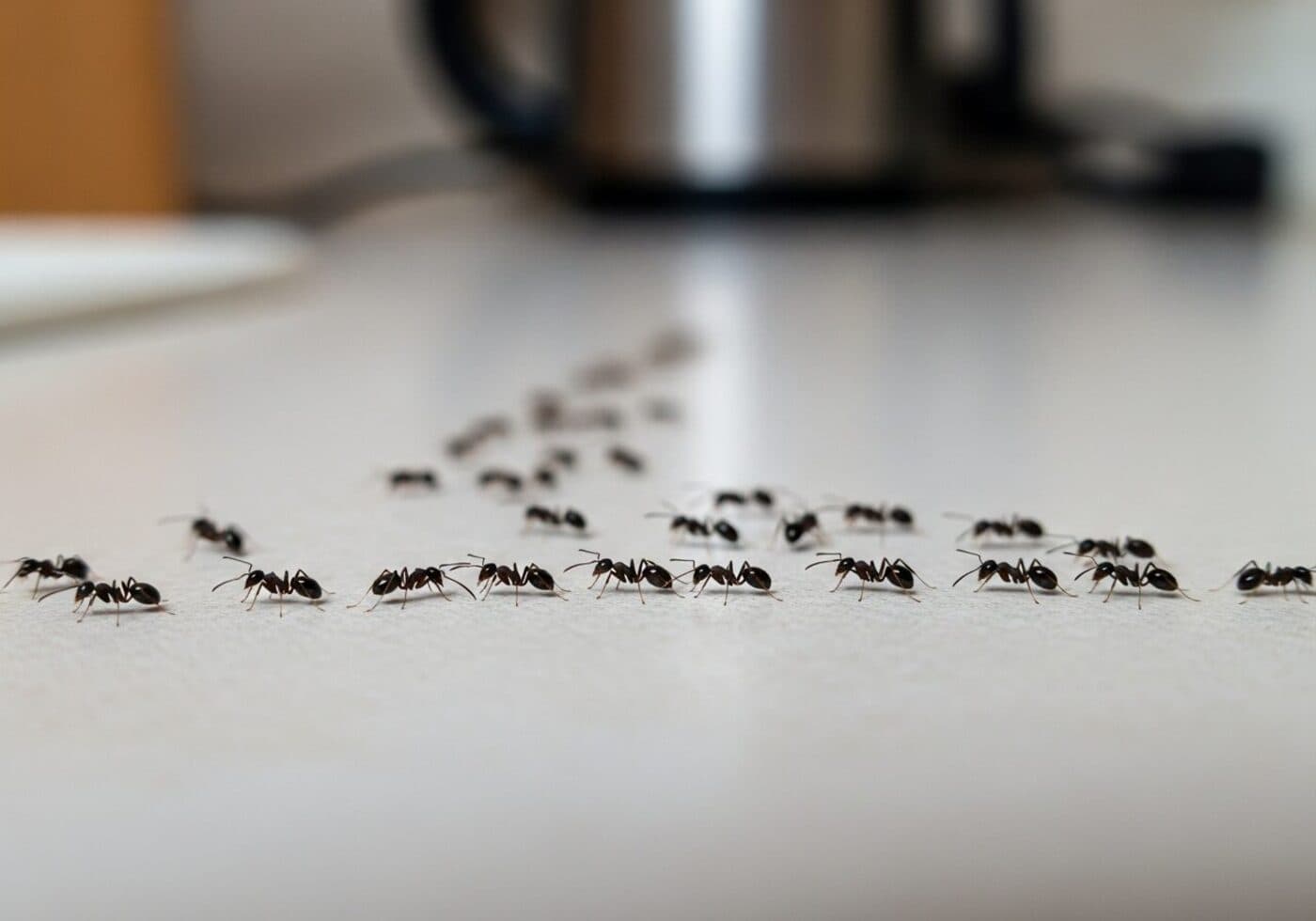
So a garden ant trail across a kitchen floor in December is telling you something specific. The nest is not outside in cold soil, it is inside the warm fabric of the building: under a heated floor slab, in a cavity near a boiler, behind an uninsulated kitchen plinth, in a ceiling void carrying pipework. That part of the building never experiences winter, so the colony never shuts down.
Here is the part that costs us work, and we say it on the phone anyway. Winter is usually the wrong time to treat it. Foraging is thin, the nest is awkward to reach, and a December treatment often buys a few quiet weeks before the same trail returns in April. The job worth doing is finding the warm, damp void hosting it, which is a survey rather than a tin of powder.
The ant that changes everything
That exception justifies bothering with identification. The pharaoh ant, Monomorium pharaonis, is a tropical species that cannot survive outdoors in the British climate. Here it lives in buildings and nowhere else, so it is not a visitor you can wait out. Its habitat is your heating.
Workers are around 2mm long, yellowish to light brown with a darker rear body. The BPCA notes that these tropical species turn up in large centrally heated buildings, listing blocks of flats, student halls and hospitals, and that infestations there are not really seasonal, though they can be encouraged when the heating goes on for the winter. Across the East Midlands the heating has just come on, which is why colonies that sat quiet in a service riser in September are moving now.
Why the wrong spray turns one nest into six
One nest holds several queens, all of them laying, so there is no single queen to remove, and BPCA guidance puts the egg to adult cycle at an average of six to eight weeks. Worse, the colonies multiply by budding: a portion of the colony, queens, workers and brood together, walks off and founds a second nest elsewhere in the building. That is not a rare accident, it is how the species normally spreads.
What triggers budding is the problem. The University of California's integrated pest management programme lists the triggers as colonies growing too large or coming under stress through changes in temperature or the availability of food and water, and states that budding may also be triggered by insecticide sprays applied to trailing workers. BPCA PestWatch guidance says it plainly: spraying the trails or nests of pharaoh ants is counterproductive and can cause more significant infestations.
A building is the worst possible setting for this. In a 2009 paper in the journal Ethology, Grzegorz Buczkowski and Gary Bennett of Purdue University found that the number of available nest sites significantly affected fragmentation: the more candidate sites, the smaller and more numerous the colony fragments. A modern building is wall to wall candidate nest sites. Stud walls, risers, conduit, ducting, suspended ceilings, pipe boxing.
So the aerosol does not simply fail. Numbers fall for a few days, then the stressed colony splits into fragments you cannot see, in three rooms instead of one. We get called to buildings that had one trail in October and four over two floors by January, and the history is nearly always months of shop bought sprays.
You cannot identify a 2mm ant from a phone photo
At 2mm the features that separate a pharaoh ant from the small dark ants people know do not survive a phone camera, so behaviour tells you more. Garden ants indoors come and go with the weather, on a route in from outside. Pharaoh ants trail continuously through the winter along warm lines such as heating pipes and electrical runs. A trail present every week since the clocks changed is not a dormant garden ant.
The BPCA advises a professional identification wherever there is doubt in a large centrally heated building, and says species such as the pharaoh ant and ghost ant should only be dealt with by a BPCA member company. We are one, with qualified technicians, so identification happens before anything is applied.
Blocks of flats, care homes and food premises
In a shared building the species question becomes a management question, because these ants use the structure, not the rooms. A heated block with continuous risers is one habitat that happens to have doors in it, the same reason that treating a single flat or unit fails for cockroaches. One flat baiting responsibly while the flat next door sprays is a losing arrangement.
In healthcare the stakes go beyond nuisance. The BPCA's PestWatch article records reports of pharaoh ants found in hospitals and, more seriously, within sterile surgical equipment. If you manage a care home or clinical area and have small pale ants trailing in winter, treat it as a this week problem.
For food businesses, a programme running over weeks has to be evidenced. Our commercial pest control work includes out of hours treatment, so baiting is not happening over open food, and audit ready documentation, so the species identified, the bait placed and the monitoring results are on record when an environmental health officer or auditor asks.
What a correct treatment looks like
- Identification first. The species is confirmed before a product is chosen, because the right answer for one ant is the wrong answer for the other.
- Non-repellent gel bait, not spray. Workers must live long enough to carry bait back to the queens and brood.
- Leave the trails alone. People find this hardest. Do not scrub the trail or move the bait, because the trail is the delivery route.
- Weeks, with follow up. Several visits with monitoring, to confirm the colony has gone rather than relocated. All our work is guaranteed and includes follow up, which here is the method, not a courtesy.
If you have ants indoors this month
Do not spray, including the aerosol already under the sink. Catch two or three ants so there is something to identify, and a strip of clear tape pressed over the trail does the job. Note where the trail runs and what it follows, particularly pipework and heating. Then leave it in place.
Then get the species confirmed. We cover Melbourne and the wider East Midlands, with same day appointments and free no obligation quotes. If it turns out to be a dormant garden ant nest in a warm cavity, we will say so, and tell you what is worth doing in spring.