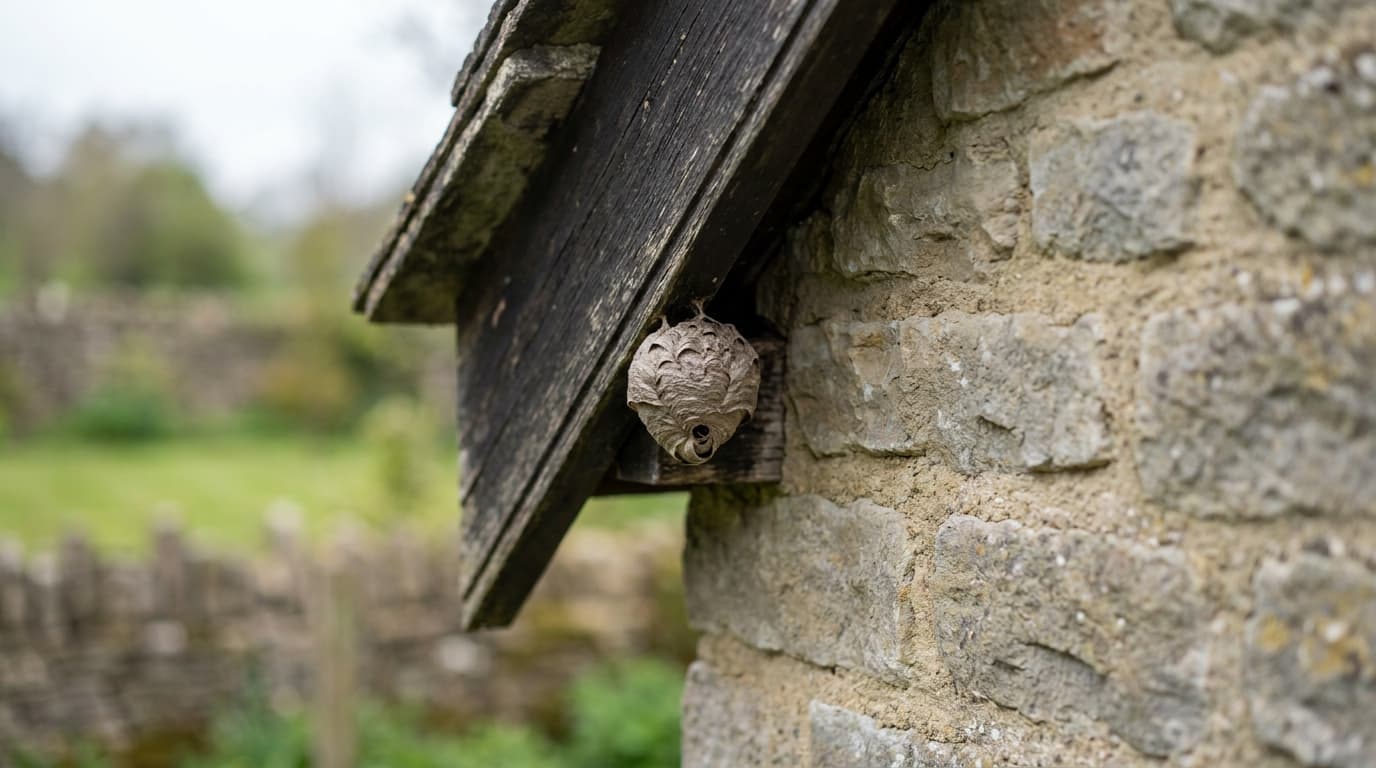
The first Asian hornet nest found anywhere in the United Kingdom this year was not in Kent. It was in Chesterfield, and it was found on 26 April 2026, more than five weeks before the next one turned up in the south east.
That one line in the official record is why this story reads differently here than it does nationally. It is also worth setting out carefully, because several of the figures published about Asian hornets this month have not matched the authorities' own record.
What the official record actually says
Everything below comes from the National Bee Unit's yellow-legged hornet rolling update, the operational record kept by the Animal and Plant Health Agency, current as at 20 August 2026. Yellow-legged hornet is the name the authorities now use for the insect most people still call the Asian hornet.
- 145 credible sightings have been reported across the UK in 2026, and 41 nests have been found.
- Nest number one of the year was an embryo nest at Chesterfield, Derbyshire, found on 26 April. Nest number two was at Matfield in Kent on 1 June.
- Kent accounts for 24 of the 41 nests. The remainder are in Hampshire, Surrey, East Sussex, Norfolk, Dorset, Greater Manchester and Derbyshire.
- The most northerly nest of the year so far is a secondary nest at Chadderton, Greater Manchester, found on 19 August.
Our sister company JG Pest Control has published the national picture, including the detail on where the widely quoted press figures went wrong. The rest of this piece is about what the record shows for our own patch.
Three East Midlands records in 48 hours, then nothing
The nest table is only half of the record. The National Bee Unit keeps a second table of individual sightings, and it shows the Chesterfield nest was not an isolated East Midlands event.
- 26 April, Chesterfield, Derbyshire. An embryo nest, reported by a member of the public.
- 27 April, Repton, South Derbyshire. A single hornet, reported by a member of the public, recorded as intercepted.
- 27 April, Sutton Bonington, Nottinghamshire. A single hornet, reported by a member of the public, recorded as intercepted.
Three records inside 48 hours, all three from members of the public rather than beekeepers, and two of the three insects intercepted rather than lost. Since then the East Midlands has not appeared in the record again.
Two things follow from that, and both matter. The first is that ordinary people reporting an insect they did not recognise is what produced the earliest record in the country this year. The second is that a short burst of records in April followed by four clear months is not the signature of an established local population. Anyone telling you the East Midlands now has an Asian hornet problem is going beyond what the record supports.
Why an embryo nest is not the same as a sighting
The National Bee Unit sorts nests into embryo, primary and secondary. An embryo nest is the small first structure a founding queen builds in spring, before there are any workers to enlarge it. A secondary nest is the large one a mature colony moves to later in the season, and that is what most of the Kent entries are.
So the Chesterfield record sitting at the top of the list in April, months ahead of everywhere else, is not a sign that Derbyshire is somehow ahead of the season. It is the opposite. It is the earliest stage of nest there is, which is exactly what you would expect to be found in April, and it means a queen was present rather than a wandering insect passing through.
What to do if you think you have seen one
The route is the same everywhere in the country, and it does not run through a pest control company.
- Report it. Use the Asian Hornet Watch app, free on Apple devices and Android, or the online reporting form linked from the National Bee Unit's page.
- Take a photograph if you can do it safely and from a distance. The reporting form asks for one specifically to help confirm the sighting, and the official record marks which entries had an image or a sample and which did not.
- Note exactly where you were. The record is kept by grid square, and a precise location is what lets the response team look for a nest nearby.
- Leave any suspected nest completely alone. Do not approach it, do not disturb it, and do not spray it.
No pest control company should treat a suspected Asian hornet nest, including us
This is the part worth being blunt about. If a nest is confirmed as a yellow-legged hornet nest, dealing with it is an official eradication response, not a job you engage a contractor for. There are good reasons for that, and they are not commercial.
A private treatment can scatter a colony rather than end it. It destroys the material the authorities need to confirm the species and to trace where the insects came from. And the official response does not stop at one nest, because finding one is the trigger to search the surrounding area for others. A well-meaning treatment on a Saturday afternoon removes the evidence and the trail at the same time.
So if you call us about a suspected Asian hornet, we will tell you to report it, and we will help you work out whether that is what you are actually looking at. We will not treat it. That is not us passing the job on, it is the correct handling of a non-native species response.
What it usually turns out to be
In our experience the overwhelming majority of late summer hornet calls across Derby, Nottingham and Leicester are native species, and late August is exactly when those calls peak. A common wasp nest that has been quietly growing since spring is at its largest and most defensive now, and European hornets are genuinely large insects that alarm people who have never seen one up close.
Both are treatable, and both are ordinary work for us. The distinguishing features between a yellow-legged hornet and the native insects it gets confused with are set out in the identification guide linked from the government's Asian hornet sightings page, and that is the reference worth checking against rather than a photograph in a newspaper.
If what you have is a wasp or a native hornet nest, that is straightforward. You can read how we deal with those on our wasp control page, or see what we cover across Derby, Nottingham and Leicester.
The honest summary
The UK's first Asian hornet nest of 2026 was found in our region, and two further insects were intercepted here the following day. Nothing since. The record does not show an East Midlands population, and it does show that public reporting is what caught all three. Learn what the insect looks like, report anything you are unsure about, and leave the nest alone.