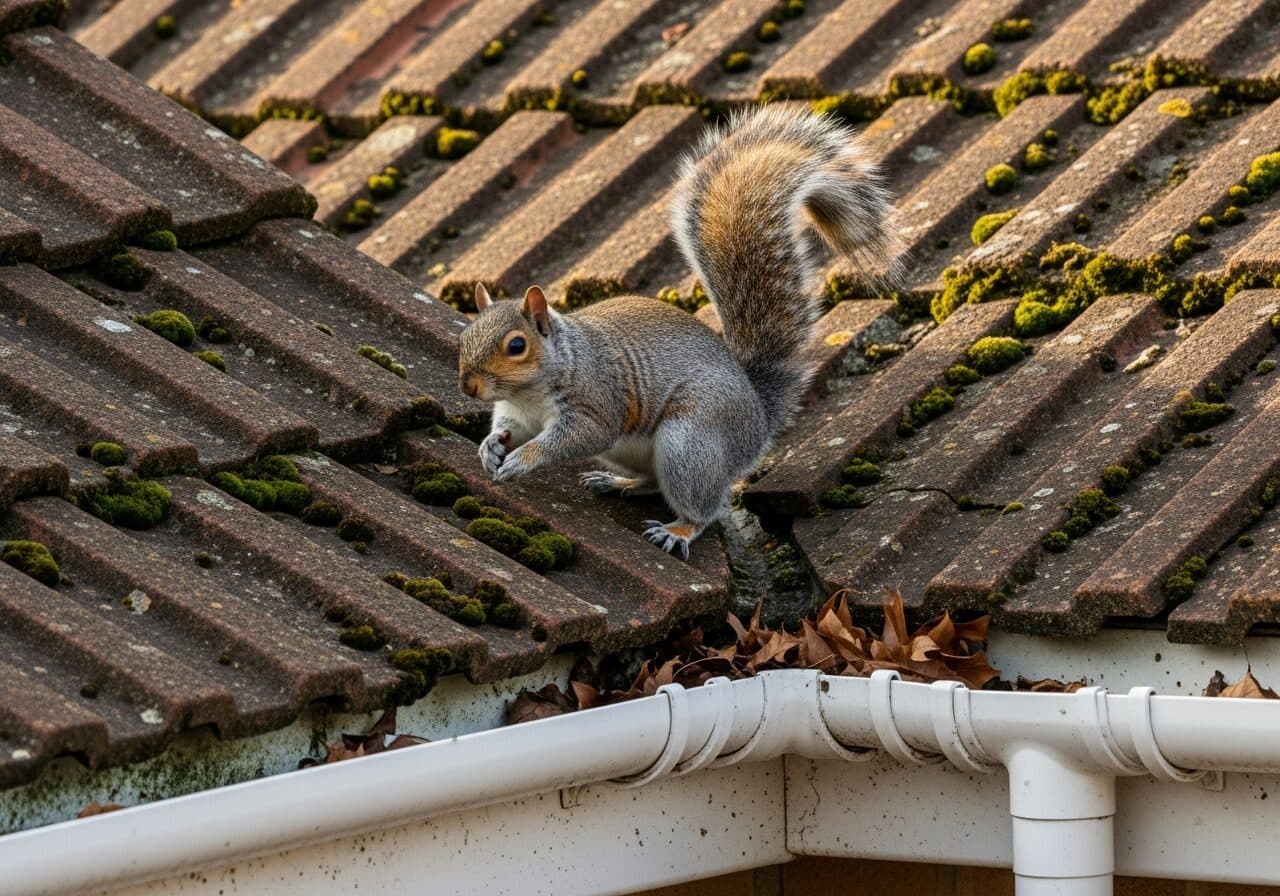
Many of the expensive grey squirrel jobs we attend between September and November were cheap jobs a fortnight earlier. They became expensive because the customer did the obvious thing first.
They found the hole, and they sealed it.
Sealing the roof first is the costly mistake
It looks like the right move. You have found the way in, so you close it. But if the squirrels are inside when the entry point closes, and in autumn they usually are, one of two things follows.
The first is that the animal gnaws its way out. A grey squirrel will work through soffit board, felt, timber and even lead flashing to leave a roof void, and the exit it makes is normally larger, and in a worse place, than the gap you just filled. You have paid for one repair and bought yourself a second.
The second outcome is worse. If it cannot get out it dies in the void, usually somewhere unreachable without cutting into a ceiling. A carcass in warm loft insulation means weeks of odour and blowflies, so a survey and a mesh panel becomes a strip-out and a plasterer.
Proofing is the right treatment. It is the last step, not the first.
The order that works
- Survey before anything is closed. Establish whether animals are inside now, and every route in use. Squirrels commonly hold two or three entry points, and the one visible from the garden is often not the favoured one.
- Carry out control while the roof is still open. This has to be done lawfully, which is covered below.
- Confirm the void is clear. Not assumed clear, confirmed, with monitoring over several days. That is what separates proofing that holds from proofing that seals an animal in.
- Proof every access point in one visit, because a squirrel will move to whichever route you left open.
- Then repair the building fabric. Rotten fascia, slipped tiles and failed flashing are a roofer's work, and proofing over decayed timber only delays the problem.
Squirrels are gnawers, not squeezers
This is where squirrel proofing differs from rodent proofing, and where a lot of well-meant work fails inside a season. Mice and rats exploit gaps that already exist and push through them. Grey squirrels take a minor weakness, a lifted tile, a soft patch of fascia, a perished mortar fillet, and enlarge it with their incisors until it admits them.
So the steel wool, expanding foam and fine mesh that see off mice are not adequate here. Squirrel proofing needs heavier gauge steel mesh, mechanically fixed at the edges rather than pressed into place, because an unsecured edge is just a handle. Foam alone is not proofing against a squirrel. It is a delay.
Why the calls start in September
Grey squirrels do not hibernate. The Woodland Trust notes that they stay active through winter, becoming less active only when food is scarce, and that they cache food underground during the autumn. That caching, and the search for a secure winter drey, is what pushes them along rooflines they ignored in July.
The Woodland Trust also records that where food is plentiful females may produce two litters of three to four young in a year. Those young disperse to find territory of their own, and a warm, dry roof void beats a drey in a windy tree.
A roofline proofed in September is closed before the pressure arrives. Inspected in November, it is closed with the animals already in residence. That is the logic behind rodent proofing before autumn, and the two surveys are sensibly done together.
What the law actually allows
The grey squirrel is listed on Schedule 9 of the Wildlife and Countryside Act 1981, and section 14 of that Act makes it an offence to release one into the wild or allow one to escape. Since the Invasive Alien Species (Enforcement and Permitting) Order 2019 came into force in England and Wales, it is also treated as a species of special concern, which further restricts keeping, breeding and transporting it.
Put plainly: a trapped grey squirrel cannot lawfully be driven to a wood and let go, and cannot lawfully be kept either. The humane relocation people picture, and often ask us for, is not a lawful option. A squirrel taken in a trap has to be dispatched humanely, and the Animal Welfare Act 2006 places a duty of care on whoever set it, which is why traps must be an approved type and checked daily.
We would rather say that at the enquiry stage than at the door. If that outcome is not one you want on your property, tell us when you book. There is real work that stops short of it, principally survey and exclusion proofing while the void is empty.
Wiring, fire, and a figure we will not repeat
Squirrels gnaw cable, and in a roof void that cable is often lighting circuits, alarm wiring and data runs stapled to joists. Stripped insulation on a live conductor sitting in dry nesting material is a poor combination, which is why we treat gnawed wiring found on a survey as work for a qualified electrician.
You will also find a widely quoted claim that some large percentage of unexplained UK house fires is caused by rodents. We will not repeat the number, because we cannot trace it to any published fire statistics, and a figure without a source is not evidence. The physical risk stands perfectly well on its own.
Commercial roof voids are a different job
In a house, a squirrel in the loft is a nuisance and a repair bill. In a school, a care home, a warehouse or an office it is also a continuity and compliance problem, and the voids are larger, partitioned and full of services. An auditor will want to see what was found, when, what was done and by whom, so every commercial visit we make is documented to a standard that stands up in an audit file. It is also why we run out-of-hours treatment for premises that cannot have technicians in the ceiling during trading. More on our commercial pest control.
When you do not need us
If a single squirrel has come down a chimney and is loose in a room, that is not a control job. Shut the internal doors, open the largest external one, leave the room, and it will normally see itself out.
And if your roofline is sound, you do not need a recurring squirrel contract. Grey squirrels get in through defects. Keep the fascia, soffits, flashing and tile line in good order and the problem largely does not arise. That is a maintenance answer, not a pest control one.
Getting it looked at
We are a British Pest Control Association member company with more than 30 years behind us, and our qualified technicians handle squirrel control across Derbyshire, Nottinghamshire and the wider East Midlands. Surveys are same-day where we can manage it, vehicles are unmarked, and every job is guaranteed with a follow-up visit.
If you can hear movement above the ceiling in daylight, get it surveyed before you seal anything. The order of operations is the whole job.