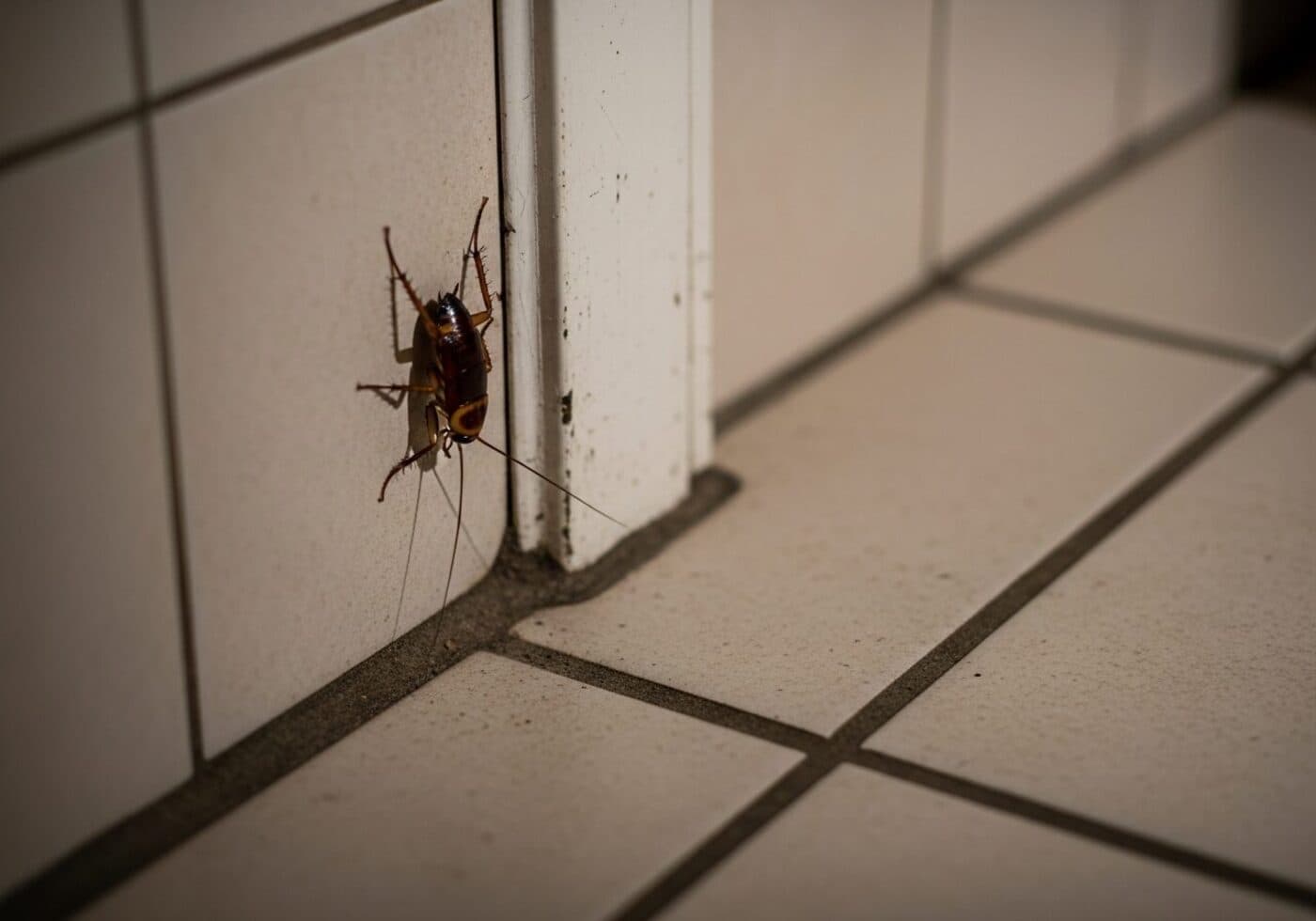
Here is the sentence that loses us work, and we say it on the phone anyway. If you are one flat in a block, one unit in a parade of shops, or one kitchen in a building with shared extract, treating your own space alone will probably not clear a German cockroach problem. Numbers drop for a few weeks, then they walk back in from next door. That is not a pitch for a bigger job, it is the most useful thing to know before you spend anything.
Cockroaches do not respect the boundary of your lease
German cockroaches move along services, not across open floors. Heating pipes, soil stacks, conduit, extract ducting, the void behind a run of fitted units, the gap where a riser passes through a slab: these are continuous routes between units, and they are warm. A building with a shared service void is, to a cockroach, one habitat that happens to have doors in it.
So a treatment confined to one unit has treated part of a population. The insects in the riser, the empty flat upstairs or the takeaway two doors along are untouched, and they recolonise. We see it most often where one tenant is conscientious and the neighbours are not.
Autumn makes a shared building worse, not better
Cockroaches get thought of as a summer problem. In heated, shared buildings the reverse is true. The German cockroach cannot survive a British winter outdoors and depends on heated structures, so communal heating from October onwards hands it breeding temperature around the clock in places nobody inspects. Below roughly 15 degrees Celsius its nymphs stop developing into adults. Inside a warm riser they never get the chance to stop.
The Oriental cockroach, which plenty of people in the Midlands still call a black beetle, works the other way around. It lives outdoors in drains and damp sheltered ground, tolerates cooler conditions, and pushes into basements, cellars and boiler rooms as outside temperatures fall. Two seasonal pressures, one conclusion: October to February is when a shared building's problem establishes itself.
Do not reach for a shop bought fogger
The instinct on seeing the first cockroach is to buy a total release fogger, sold as a bug bomb, and set it off. It does not work, and that is published record, not opinion.
Writing in the Journal of Economic Entomology in 2019, Zachary DeVries and Coby Schal of North Carolina State University tested foggers against cockroaches from infested apartments. More than 62 per cent of the insects in treated rooms survived, against under 10 per cent of a laboratory strain with no resistance history. Over 96 per cent of those screened carried a mutation conferring pyrethroid resistance, and resistance to cypermethrin, a common fogger ingredient, measured around 202 times that of the susceptible laboratory strain.
A fogger puts insecticide on open surfaces and almost none inside the harbourage where cockroaches sit. Its main achievement is to push the population further into the building, which in a block means into your neighbours' kitchens.
The egg case is why the rebound lands at about week four
A German cockroach female carries her egg case attached to her abdomen until the nymphs are nearly ready to hatch, and the University of Florida extension guide to the species puts a typical case at 30 to 40 eggs. Shielded inside that capsule, they are out of reach of a residual product.
So a treatment can look like a success. Sightings stop, and three to five weeks later a fresh generation of nymphs appears. A one visit job was never going to work. We book cockroach work as a sequence with follow up built in, and the follow up is not an upsell.
Resistance means the plan matters more than the product
German cockroaches develop resistance quickly, and not only to what they have met. A 2019 study in Scientific Reports by a Purdue University team led by Michael Scharf ran three strategies over six months in low rise housing in Indianapolis and Danville, Illinois. Rotating three insecticides from different classes held populations flat but could not reduce them. A two insecticide mixture failed outright. Scharf's figure for the pace of it is the one to remember: a single generation could show a fourfold to sixfold increase in resistance.
Treatment is not hopeless. But the active ingredient is the least interesting part of the job. What decides the outcome is the survey: finding every harbourage, placing monitors so the next visit measures rather than guesses, and getting gel bait into the voids where the insects live rather than onto surfaces they cross.
What a survey of a shared building has to cover
- Every unit sharing a wall, floor, ceiling or service route with the one that reported.
- Risers, ducts, boiler rooms, bin stores and communal voids, where the reservoir usually sits.
- Behind and under fixed equipment: fridge motor housings, dishwasher cavities, the warm gap behind a cooker, kick boards and cracked grouting.
- Monitors left in place and read on a schedule, so the next visit contains numbers instead of opinions.
- Species identification, since German and Oriental cockroaches harbour in different places.
Access is the hard part, not the entomology. In a block that means the freeholder or managing agent has to be in the conversation; in a parade of shops, the neighbouring tenants. A job limited to the units that agreed has a known weak point. Better to know now than in February.
For a food business, the paperwork is part of the control
Cockroach evidence found during an environmental health inspection is a serious matter, not a note for next time. Under the Food Safety Act 1990 an officer can serve an emergency prohibition notice where there is an imminent risk to health, closing premises or equipment immediately and going to a magistrates' court afterwards. Live cockroaches in a kitchen can take you there.
What stands up for you is a record: survey findings, dated monitor readings, what was applied and where, proofing recommendations and whether they were actioned. We provide audit ready documentation for commercial pest control clients for that reason, and treat out of hours so a kitchen does not lose a service, whether that is a site here in Derbyshire or commercial premises in Nottingham.
When you probably have no cockroach problem
A good share of the cockroach calls we take are not cockroaches. The black ground beetles that gather around back doors in autumn get mistaken for Orientals constantly, and one dark insect, once, with nothing on a monitor, has probably walked in from the garden. Send a photograph before booking anything. If it is a beetle we will say so.
Getting it looked at properly
After a confirmed sighting in a shared building, the first useful step is a survey allowed to cross the unit boundary. We are a BPCA member company, our technicians are qualified, our vehicles are unmarked and our quotes carry no obligation. Our cockroach control page sets out how the programme runs, and rodent proofing before autumn covers what else is moving indoors now.
If the job needs your managing agent before it needs us, we will tell you that first.